> For the complete documentation index, see [llms.txt](https://docs.solutioo.de/llms.txt). Markdown versions of documentation pages are available by appending `.md` to page URLs; this page is available as [Markdown](https://docs.solutioo.de/dhl-connector/dhlconnector_en_us/configuration/pakete-anlegen.md).
# Creating Packages
In this setup, you define the **packaging types** available for shipment.\
You specify their **dimensions** and assign the corresponding **DHL parcel or packet type**.
Only the packaging options defined here will be available when creating a **shipping label**.\
Therefore, **every type of packaging**—even those used only once—must be created here!
{% hint style="info" %}
To access the **Basic Settings**, proceed as follows:
[Getting Started](/dhl-connector/dhlconnector_en_us/getting-started/lizenzerwerb.md)
{% endhint %}
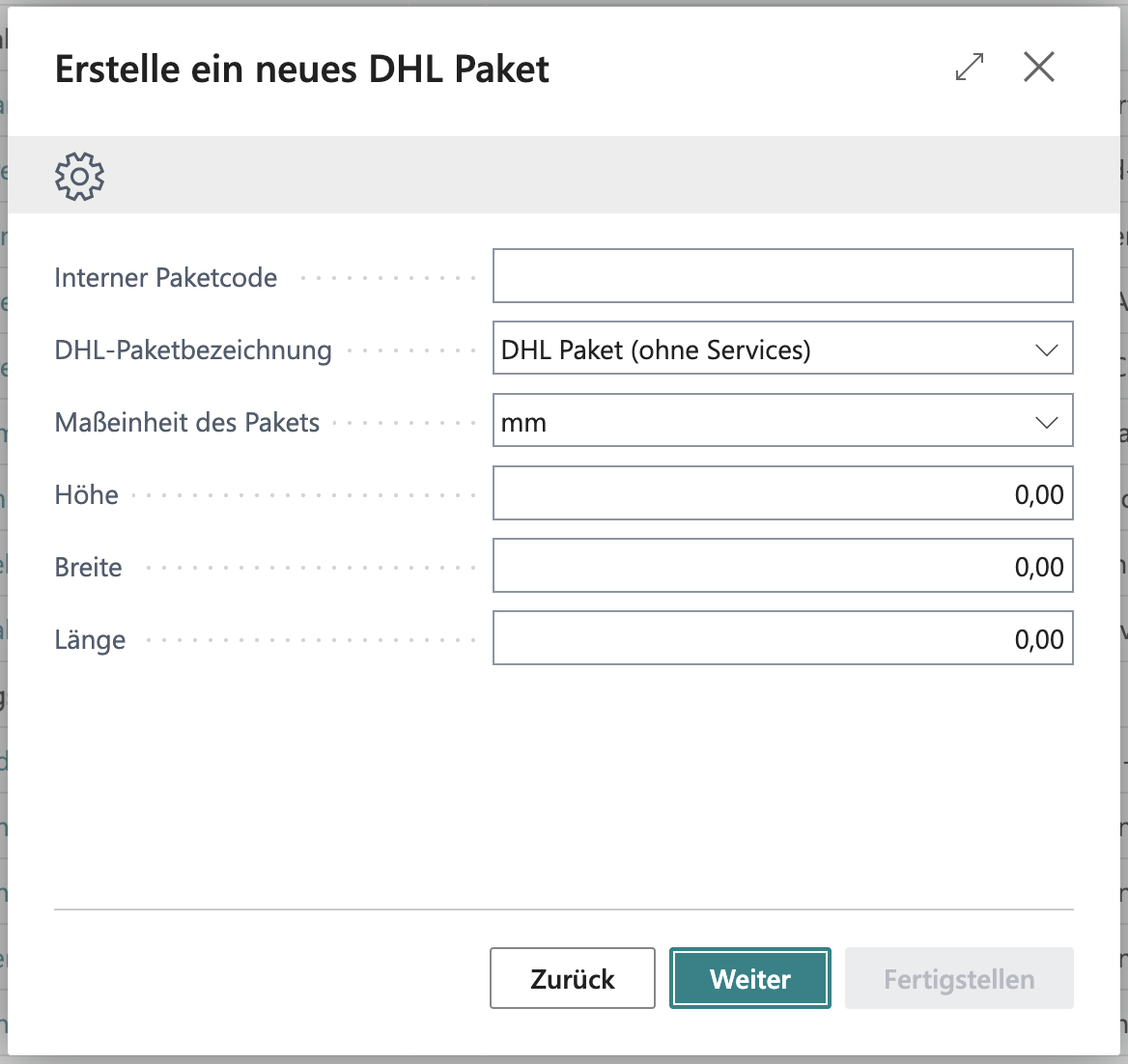
When you start the **guided setup**, a pop-up window will open.\
Click *“Next”* to begin the configuration.
## **Creating a Package**
Hovering over each field name will display additional information.
#### **Internal Package Code**
Define this code for **internal identification** of your packages.
#### **DHL Package Type**
In the drop-down list, you’ll find all parcel and packet types offered by DHL.\
Depending on your **DHL contract**, not all of these options may be available to you.
#### **Unit of Measurement**
Choose between **cm** and **mm** as the unit for the dimensions defined below.
#### **Height**
The height of the package in the selected unit.
#### **Width**
The width of the package in the selected unit.
#### **Length**
The length of the package in the selected unit.
After entering all the required information, click *“Next”* and then *“Finish”* to create the package and complete the setup.
## Overview of All Packages
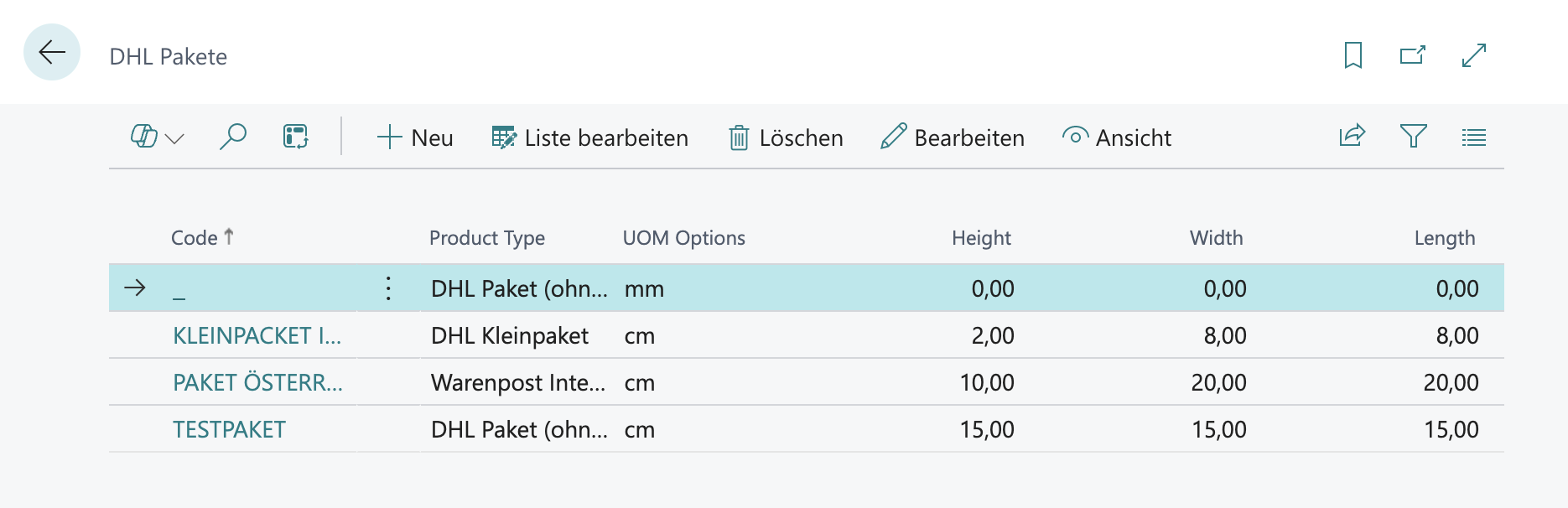
Before finishing, you will be informed that you can **view all created packages** via:\
*Search > “DHL Packages.”*
You can also access this page from the **sales order overview** under:\
*Actions > DHL Print > DHL Packages.*
---
# Agent Instructions
This documentation is published with GitBook. GitBook is the documentation platform designed so that both humans and AI agents can read, navigate, and reason over technical content effectively. Learn more at gitbook.com.
## Querying This Documentation
If you need additional information that is not directly available in this page, you can query the documentation dynamically by asking a question.
Perform an HTTP GET request on the current page URL with the `ask` query parameter, and the optional `goal` query parameter:
```
GET https://docs.solutioo.de/dhl-connector/dhlconnector_en_us/configuration/pakete-anlegen.md?ask=&goal=
```
`ask` is the immediate question: it should be specific, self-contained, and written in natural language.
`goal` is optional and describes the broader end goal you are ultimately trying to accomplish on behalf of the user. GitBook uses it to tailor the answer towards what is most useful for that goal.
The response will contain a direct answer to the question and relevant excerpts and sources from the documentation.
Use this mechanism when the answer is not explicitly present in the current page, you need clarification or additional context, or you want to retrieve related documentation sections.