> For the complete documentation index, see [llms.txt](https://docs.solutioo.de/llms.txt). Markdown versions of documentation pages are available by appending `.md` to page URLs; this page is available as [Markdown](https://docs.solutioo.de/dpdconnector/dpdconnector_en_us/configuration/grundlegende-einstellungen.md).
# Basic settings
{% hint style="info" %}
To access the **Basic Settings**, proceed as follows:
[Getting Started](/dpdconnector/dpdconnector_en_us/getting-started/lizenzerwerb.md)
{% endhint %}
When you start the **guided setup**, a pop-up window will open.\
Here you’ll also find a reference to this documentation in case you encounter any questions or issues.\
Click *“Next”* to begin the actual setup process.
## **1. Mode Selection**
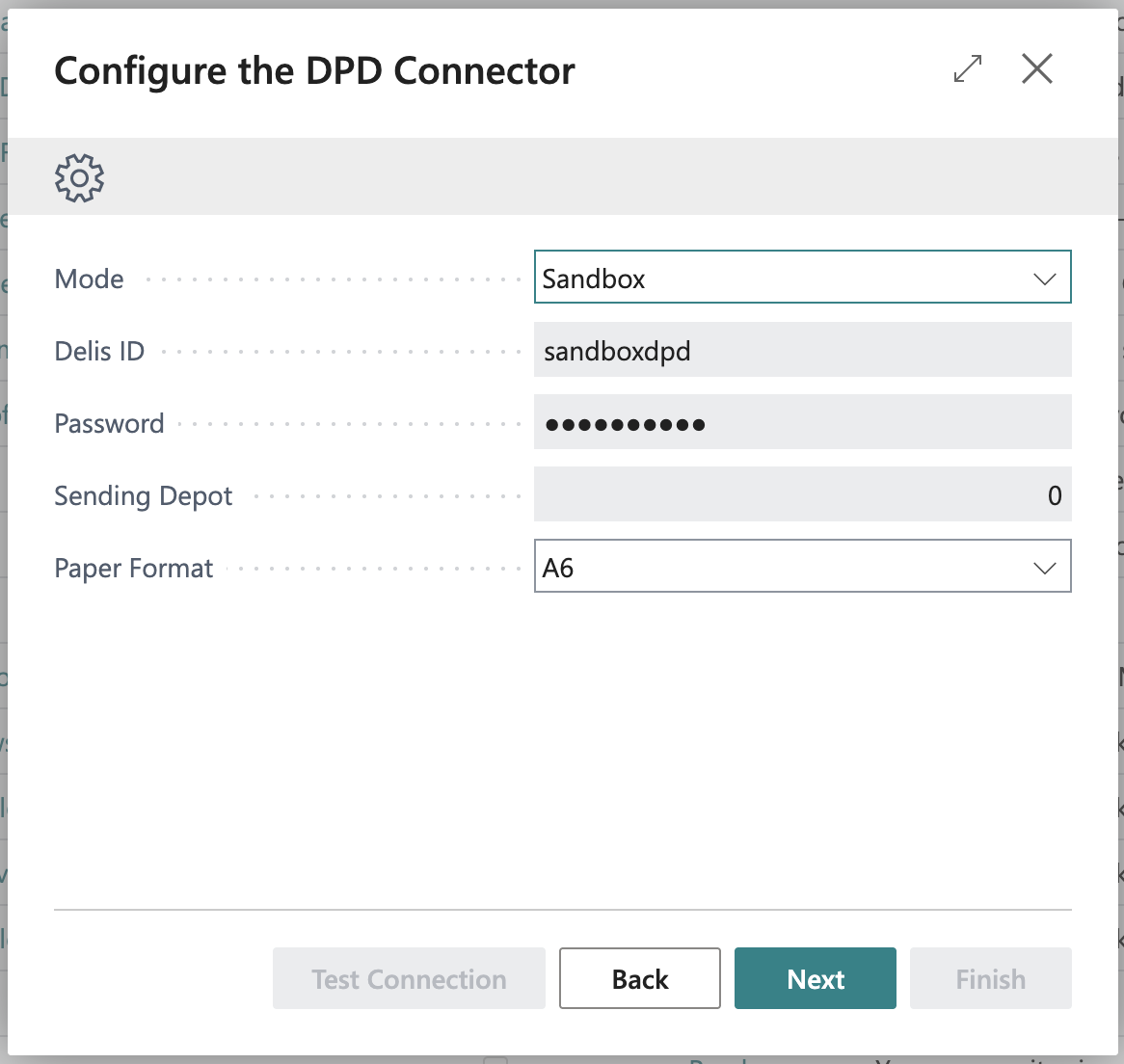
In the first step, you can choose whether to start the connector in **Production Mode** or **Sandbox Mode**.
If you select "*Sandbox"*, entering your customer account data is **not required**.
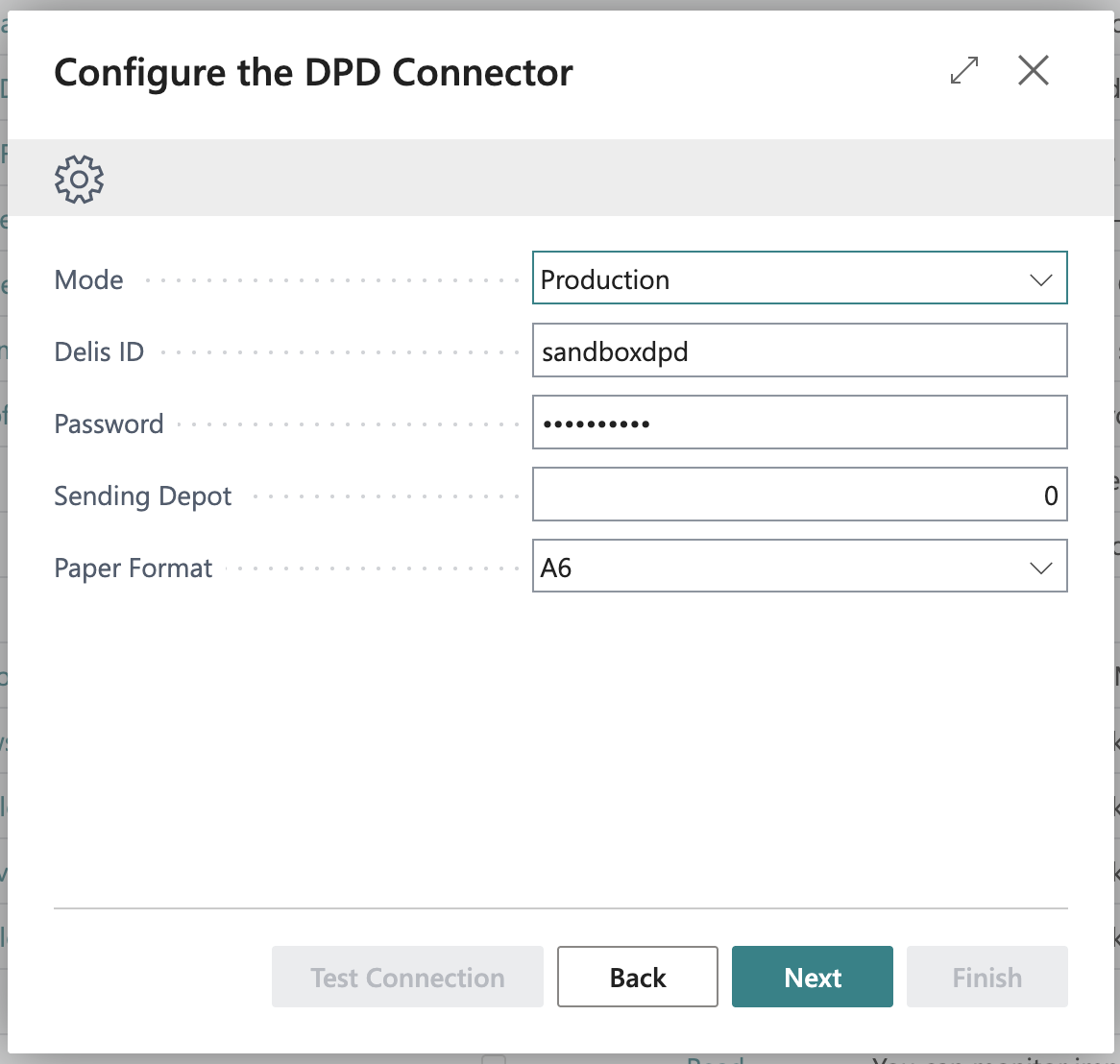
Only when switching to "*Production"* will an additional configuration screen appear, prompting you to enter your Delis ID, password and sending depot for the DPD Business Customer Portal.
{% hint style="warning" %}
To avoid input errors, copy your Delis ID and password into a text document first, verify them, and then paste them into Business Central. Extra spaces before or after the input often cause errors.
{% endhint %}
After entering your data, click *“Next”* to continue.
## **2. Sender Data**
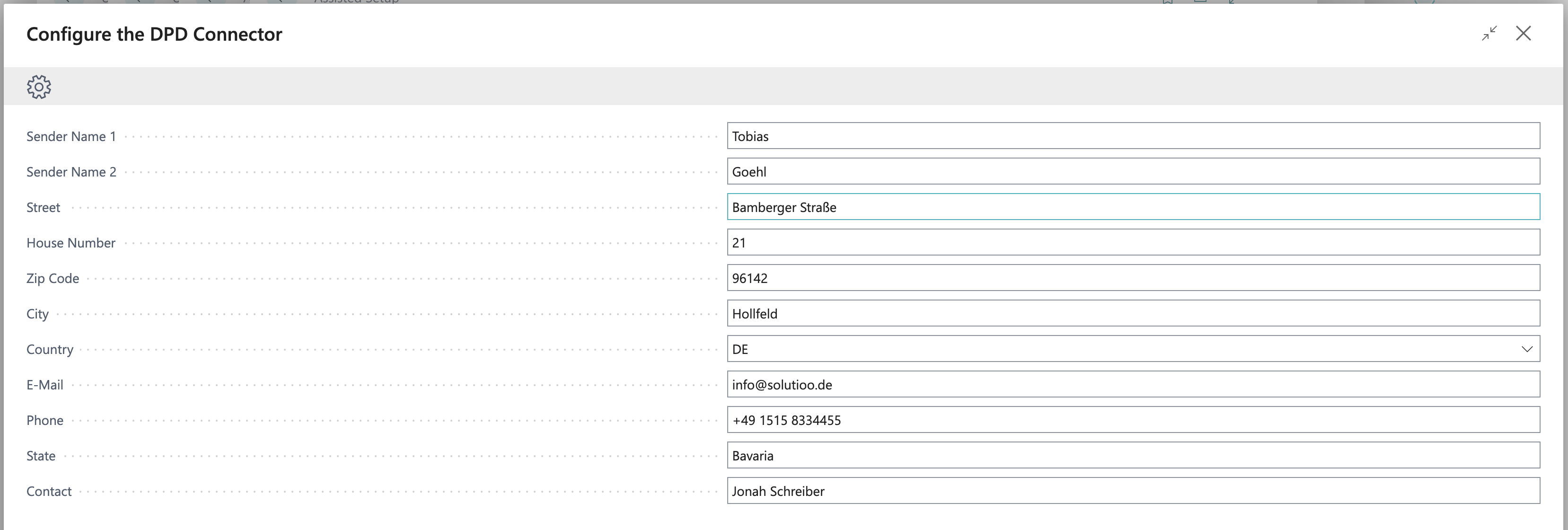
In the second step, you’ll be asked to provide your **sender information**.\
It’s best to **maximize the pop-up window** by clicking the *“Expand”* icon in the top-right corner (next to *“Close”*) so that all rows are clearly visible.
Hovering over each field label displays additional information.
#### **Sender Name 1**
Enter the sender’s name that should appear on the shipping label. This can be a person’s name or a company name.
#### **Sender Name 2**
Optionally (!) add a second line for the sender’s name — for example, a last name or additional company details.
#### **Street**
Enter the sender’s street name.
#### **House Number**
Enter the house number of the sender’s address.
#### **Zip Code**
Enter the postal code of the sender’s address.
#### **City**
Enter the city of the sender’s address.
#### **Country**
Select the country of the sender’s address from the dropdown menu.
#### **E-Mail**
Enter the sender's email address to be displayed on the shipping label.
#### **Phone**
Enter the sender’s phone number.
#### **State**
Enter the state or province of the sender’s address (if applicable).
#### **Contact**
Enter the contact person for the sender’s address (if applicable).
## **3. Test the Connection**
**If all fields are filled out completely, click “Next” to proceed to the final page.**\
There, you can test the connection to DPD by clicking the button.\
If the test fails, please review your entries carefully for typos or formatting errors.
## **4. Done!**
Click *“Finish”* to complete the configuration.
Your **DPD Connector setup** is now complete and ready for use!
---
# Agent Instructions
This documentation is published with GitBook. GitBook is the documentation platform designed so that both humans and AI agents can read, navigate, and reason over technical content effectively. Learn more at gitbook.com.
## Querying This Documentation
If you need additional information that is not directly available in this page, you can query the documentation by asking a question.
Perform an HTTP GET request on the following URL with the `ask` and `goal` query parameters:
```
GET https://docs.solutioo.de/dpdconnector/dpdconnector_en_us/configuration/grundlegende-einstellungen.md?ask=&goal=
```
`ask` is the immediate question: it should be specific, self-contained, and written in natural language.
`goal` is what the user is ultimately trying to achieve, the reason they need the answer. Sharing it helps GitBook give you a better, more relevant answer. A goal is most helpful when it describes the outcome the user wants rather than restating the question. For example, with `ask=how do I create an API token`, a goal like `automate deployments from our CI pipeline` lets GitBook tailor the answer to that use case.
The response will contain a direct answer to the question and relevant excerpts and sources from the documentation.
Use this mechanism when the answer is not explicitly present in the current page, you need clarification or additional context, or you want to retrieve related documentation sections.