> For the complete documentation index, see [llms.txt](https://docs.solutioo.de/llms.txt). Markdown versions of documentation pages are available by appending `.md` to page URLs; this page is available as [Markdown](https://docs.solutioo.de/shopware/shopware6_en_us/configuration/basic-settings/customer-configuration.md).
# Customer Configuration
The customer settings determine how customer data is synchronized between Shopware and Business Central.
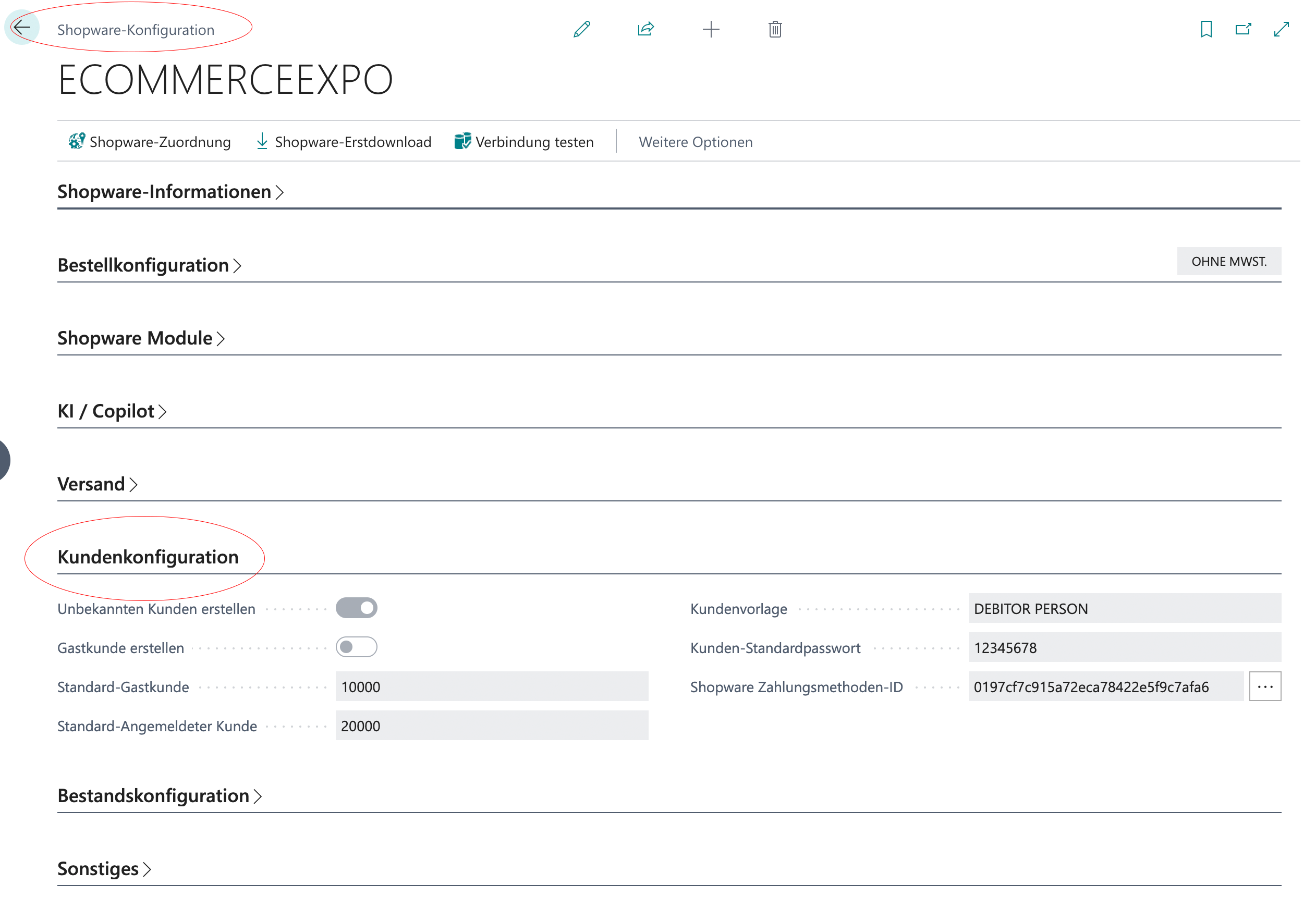
## 1. Customer Settings
Navigate to *"Shopware"* :right: *"Configuration"* and switch to edit mode by clicking the "pencil icon" at the top of the newly opened window. Editing is now enabled.
* **Create Unknown Customer**\
**YES** :right: YES makes it possible to create an unknown customer in Business Central. This is particularly relevant for B2C shops that do not want to create a customer in BC for every guest order.
* **Create Guest Customer**
*YES* :right: With YES, a guest customer may be created in Business Central when a web order is placed without a Shopware customer account.
* **Default Guest Customer**\
Here you define the default customer for guest orders. A new contact is created within the customer for every order.
* **Default Logged-In Customer**\
Select the customer account that is used to create all Shopware orders, but only if the customer has a Shopware account and is not synchronized with a Business Central account.
* **Customer Template**\
The customer template is used when "*Create Unknown Customer*" is set to *YES* and no *"Default Guest"* / *"Logged-In Customer"* has been defined. It is the default customer template for Business Central accounts that were created from Shopware.
* **Customer Default Password** (will be removed in the next software update because it is redundant)
* **Shopware Payment Method ID**\
Here you define the default payment method for Shopware. If a customer has no payment method defined on the customer record, this one is transmitted instead. You will find the ID in the Shopware back end under "*Settings*" :right: "*Tax*" :right: "*Standard rate*":right: the URL suffix after detail/\  ## 2. B2B vs. B2C Customers
{% tabs %}
{% tab title="B2C customers (private customers)" %}
* Are typically assigned to a collective account.
* Or created as individual customers.
{% endtab %}
{% tab title="B2B customers (business customers)" %}
* Are always created as individual customers.
* Can have their own price groups.
* Payment terms may differ.
For more information, see [Specifics for B2B/B2C Customers](/shopware/shopware6_en_us/customer-management/specifics-for-b2b-b2c-customers.md)
{% endtab %}
{% endtabs %}
## 3. Synchronizing Customer Data
{% tabs %}
{% tab title="From Shopware to BC" %}
During order import, customer data is updated automatically or new customers are created.
{% endtab %}
{% tab title="From BC to Shopware" %}
There is currently no automatic synchronization from BC to Shopware. Changes to customer data must be made manually in Shopware.
{% endtab %}
{% endtabs %}
{% hint style="warning" %}
Do not change the **customer number** afterwards, as this breaks the mapping between the systems.
{% endhint %}
---
# Agent Instructions
This documentation is published with GitBook. GitBook is the documentation platform designed so that both humans and AI agents can read, navigate, and reason over technical content effectively. Learn more at gitbook.com.
## Querying This Documentation
If you need additional information that is not directly available in this page, you can query the documentation dynamically by asking a question.
Perform an HTTP GET request on the current page URL with the `ask` query parameter, and the optional `goal` query parameter:
```
GET https://docs.solutioo.de/shopware/shopware6_en_us/configuration/basic-settings/customer-configuration.md?ask=&goal=
```
`ask` is the immediate question: it should be specific, self-contained, and written in natural language.
`goal` is optional and describes the broader end goal you are ultimately trying to accomplish on behalf of the user. GitBook uses it to tailor the answer towards what is most useful for that goal.
The response will contain a direct answer to the question and relevant excerpts and sources from the documentation.
Use this mechanism when the answer is not explicitly present in the current page, you need clarification or additional context, or you want to retrieve related documentation sections.
## 2. B2B vs. B2C Customers
{% tabs %}
{% tab title="B2C customers (private customers)" %}
* Are typically assigned to a collective account.
* Or created as individual customers.
{% endtab %}
{% tab title="B2B customers (business customers)" %}
* Are always created as individual customers.
* Can have their own price groups.
* Payment terms may differ.
For more information, see [Specifics for B2B/B2C Customers](/shopware/shopware6_en_us/customer-management/specifics-for-b2b-b2c-customers.md)
{% endtab %}
{% endtabs %}
## 3. Synchronizing Customer Data
{% tabs %}
{% tab title="From Shopware to BC" %}
During order import, customer data is updated automatically or new customers are created.
{% endtab %}
{% tab title="From BC to Shopware" %}
There is currently no automatic synchronization from BC to Shopware. Changes to customer data must be made manually in Shopware.
{% endtab %}
{% endtabs %}
{% hint style="warning" %}
Do not change the **customer number** afterwards, as this breaks the mapping between the systems.
{% endhint %}
---
# Agent Instructions
This documentation is published with GitBook. GitBook is the documentation platform designed so that both humans and AI agents can read, navigate, and reason over technical content effectively. Learn more at gitbook.com.
## Querying This Documentation
If you need additional information that is not directly available in this page, you can query the documentation dynamically by asking a question.
Perform an HTTP GET request on the current page URL with the `ask` query parameter, and the optional `goal` query parameter:
```
GET https://docs.solutioo.de/shopware/shopware6_en_us/configuration/basic-settings/customer-configuration.md?ask=&goal=
```
`ask` is the immediate question: it should be specific, self-contained, and written in natural language.
`goal` is optional and describes the broader end goal you are ultimately trying to accomplish on behalf of the user. GitBook uses it to tailor the answer towards what is most useful for that goal.
The response will contain a direct answer to the question and relevant excerpts and sources from the documentation.
Use this mechanism when the answer is not explicitly present in the current page, you need clarification or additional context, or you want to retrieve related documentation sections.